Showing posts with label Literacy Stations. Show all posts

Literacy Stations - Teacher Time

Today as I bring my Literacy Stations blog series to a close I'm going to share some ideas for what you can do with small groups while the rest of your kiddos are at Literacy Stations.  The nice thing about Literacy Stations is all of your students will be busy with their partners or small groups working on their Literacy Stations, which will leave you free to pull small groups. Yes, this will take time to get to this point and it won't happen Day #1 (see Classroom Management blog post), but you will get there.


Here are some ideas and things to check out to use with your small groups....

Florida Center for Reading Research:
FCRR has many great activities that you can use in your small literacy groups.  They cover all of the Big 5 areas - Phonemic Awareness, Phonics, Fluency, Vocabulary, and Comprehension and span multiple grade levels, which is great for differentiation. I highly recommend you check them out.

Readworks:
I absolutely love Readworks. Teacher accounts are free and there are tons of reading comprehension passages and questions on there.  They have them broken down into different skills and reading levels.  Perfect to use with students who need comprehension practice.

Book Studies:
I love using book studies during small groups.  I pick or have the kids pick chapter books and then they do a book club with their group and myself.  Great way to practice independent reading, working with a group, comprehension and writing skills. I have many book studies in my TPT Store including: Jake Drake Series, Ivy and Bean (Books 1-3), Nate the Great Goes Undercover, Nate the Great and the Lost List, Cam Jansen The Mystery of the Dinosaur Bones, Flat Stanley Framed in France, I Survived, The Great Chicago Fire, Surprises According to Humphrey, Charlie and the Chocolate Factory, and more coming in the future. You can find them in my TPT store...here...

No automatic alt text available.


Grammar Fix Its:
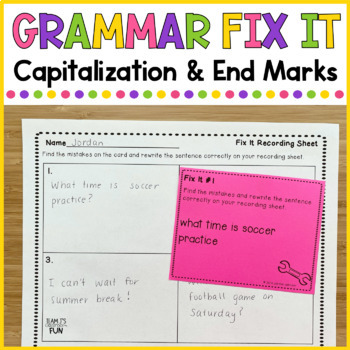
Another skill I work on with students during small groups is grammar. I have Grammar Fix Its in my store that cover: capitals, end marks, commas, apostrophes, verb tense, quotation marks, and high frequency spelling.  These are quick practice cards that can be worked on in a small group or a station.  You can find them in my TPT store...here....

Grammar Fix It - Capitalization & End Marks

Other Activities for Lit Groups in my TPT Store:

Synonyms and Antonyms Sort - Great practice sorting word pairs.
No automatic alt text available.

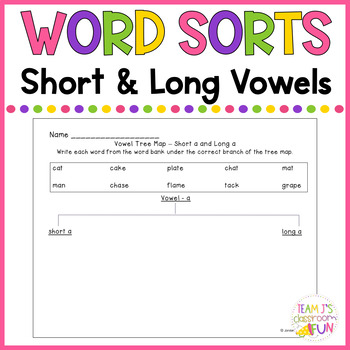
Short and Long Vowel Tree Maps - Great phonics practice with short and long
Short and Long Vowel Tree Maps

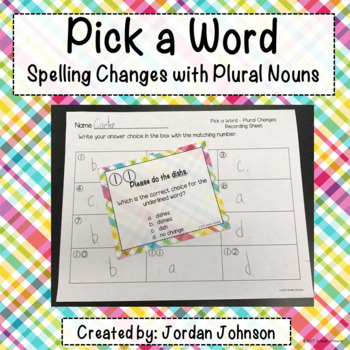
Pick a Word - Spelling Changes with Plural Nouns - practice identifying the correct plural noun.

Pick a Word - Spelling Changes with Plural Nouns

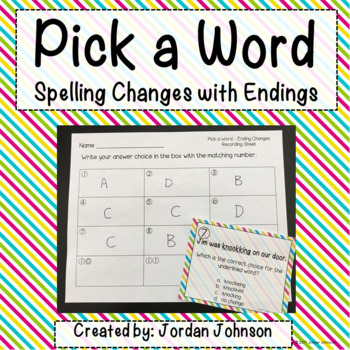
Pick a Word - Spelling Changes with Endings


Thank you for checking out my Literacy Station Blog Series.

Check out past Literacy Station blog posts:
Introduction
Set-Up

Literacy Stations - Other Stations Ideas

Today I'm going to be sharing some ideas for other Literacy Stations I have used in the past. Most of these I've used when I taught first grade and they could also work for Kindergarten. Some of them can also be adapted to work for 2nd grade and up.


Boggle Station: I used this station in first grade and second grade and it was a lot of fun! Great opportunities to practice word building. I did make my own Boggle Chart with foam board and cardstock, but there are many paper options available too.

Here are the I Can options for Boggle Station:

  • I can find words on the Boggle Board.
  • I can record my words on my recording sheet.


ABC Station: This station would work very well for Kindergarten and 1st Grade. I had ABC puzzles at this station and alphabet books too.

Here are a few I Can options for ABC Station:
  • I can make a letter booklet.
  • I can put sight word puzzles together.
  • I can put ABC puzzles together.
  • I can practice flashcards.
  • I can read ABC books.
  • I can create my own ABC Book.


Handwriting Station: Another great station for Kindergarten and 1st Grade. Handwriting is a skill we were constantly reviewing so having it as a station for review was perfect.

For this station, I made sure we had our alphabet with proper letter form available on a page so they could see how the letters were supposed to look.  The Letter Wipe-Off boards were handwriting practice pages that I laminated. Students could trace with a white board marker and then erase when finished.  I had a list of class names at this station so kids could practice writing their friend's names.  The poems and sentences listed below often fit our story or phonics skill for the week so they were able to work on 2 skills at once.

I Can Options for Handwriting Station:

  • I can write my letters on paper with a pencil.
  • I can write my letters on a white board.
  • I can practice letter on the wipe-off boards.
  • I can write the class names on a paper or a white board.
  • I can write the poems or sentences in my best handwriting.


Write the Room Station: I don't have pictures of this station, but I loved using it in 1st grade because it got the kids up and moving.

Write the Room Station Ideas:
  • I can search for words that have a certain letter in it.
  • I can search for nouns around the room.
  • I can search for short vowels, long vowels around the room.
  • I can fill out the around the room response sheet and write sentences with the words I found.


Listening Station: Another great station for Kinder-2nd grade.  At listening station, you could use cassette tapes or books on CD if you have access to a CD player with multiple headphone option. I've also had iPods in a classroom before and iPads and loaded books on CD onto them for the kids to listen to.

Listening Station I Can Options:
  • I can listen to my story.
  • I can talk with my partner about the story when we're done.
  • I can complete my reading response (draw a picture of my favorite part, write about my favorite part give my opinion of the book, story map, cause/effect, etc).

Making Words Station: Another great station for Kinder - 2nd. I have the Making Words book and have used many of the letters and word options from there.  You could cut up some letters or have some letter tiles available at this station and see how many words the kids can make. The nice thing about this is you can fit the letters you pick to fit the spelling or phonics skill of the week.


Making Words Station Ideas:
  • I can take my letters out of the envelope.
  • I can move the letters around to make words.
  • I can record the words I find on my recording sheet.
  • I can use those words found to create my own sentences or story.


Poetry Station: Poetry station would work with any age group because you can differentiate the poetry material you provide.

Poetry Station I Can Ideas:
  • I can read the poems (poetry books at the station or binder of poems).
  • I can write my own poem.
  • I can illustrate a poem
  • I can compare and contrast two poems.

Thank you for reading my post about Other Station Ideas.  Check back Sunday for the last installment of the Literacy Station Series. On Sunday I'll be sharing what I do with small groups while my kids are at Literacy Stations.


Check out past Literacy Station blog posts:
Introduction
Set-Up

Literacy Stations - Spelling Station Ideas

Today I'm going to share some ideas for Spelling Station. This could be used for most grade levels with any list of spelling words.

Spelling Station has always been one of my favorite stations.  In second grade, I have my students complete their work in a spiral notebook that it for Literacy Station activities.  Students could complete these activities on a blank page of paper or on a white board, too.  I've also used many of these activities in first grade.  For this station, I do print our list of spelling words each week and put them in a sheet protector. Students take the spelling list, task cards, and their notebook and get to work!


Here are some I Can options for Spelling Station:

  • I can decorate my spelling words. (students are able to use markers and crayons and write their spelling words with block letters, bubble letters, designs, etc.)
  • I can practice my spelling words on a white board. 
  • I can write my words using magnets. (This was a popular one in 1st grade)
  • I can use my words in a sentence or a story.
  • I can put my words in ABC order.
  • I can stamp my spelling words. (Another popular option in 1st grade).
  • I can write my words three times.


Thank you for reading my post about Spelling Station.  Check back Thursday for information on Other Station Ideas that you could use in your classroom including: Boggle Station, Making Words Station, ABC Station, and more.

Check out past Literacy Station blog posts:
Introduction
Set-Up

Literacy Stations - Informational Station Ideas

Today I'm going to share some ideas for an Informational or Nonfiction Station.

These ideas I have created or compiled from research, Pinterest, blogs, etc.  

Here are the I Can options for Informational Text Station:
  • I can read a nonfiction book.
  • I can look for text features in the book and fill out the text feature page (tons of options on TPT and Pinterest with different text feature pages).
  • I can write a report about a topic I read about.
  • I can write a newspaper article about a topic I read about.
  • I can write interview questions to interview someone about a topic I read about.
  • I can write 4 facts or more that I learned from the book.
If you are interested in a quick Info Text Facts Printable - check out my FREEBIE in my TPT Store...here...


Thank you for reading my post about Informational Text Station.  Check back Tuesday for information on my Spelling Station.

Check out past Literacy Station blog posts:
Introduction
Set-Up

Literacy Stations - Writing Station Ideas

Today I'm going to share my ideas for Writing Station. I have used Writing Station in my first and second grade classrooms. I have also seen this station used in Kindergarten and older grades.

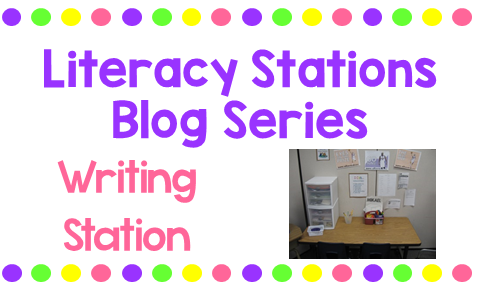
Writing Station will typically be a station with lots of materials. If possible, it's great to have it at a set desk or table so all of the materials can be accessed and it's easy to get to.  Currently I do not have a dedicated table or desk.  I house my materials in Sterilite drawers on a bookshelf.  Students come over and get out what they need. I also have a caddy that has markers, crayons, etc that they can take to their seats to use.

Here are materials that I include at my Writing Station:
Markers, crayons, stickers, blank paper, stationary/fancy paper, note cards, envelopes, postcards, letter writing paper, list paper, and comic strip paper.

This picture is from my old 1st grade classroom. I had a designated table area for Writing Station. You can see the drawers and items available for the kids to use.
Here is a table set-up in one of my second grade classrooms...

Here are the I Can ideas for Writing Station:
  • I can write a story.
  • I can write a letter or a card to a friend.
  • I can make a list.
  • I can write an opinion using the opinion prompts.
  • I can write to answer other writing prompt cards.
One of my favorite writing prompt task cards that I use at Writing Station are my Opinion Writing Prompt Cards. Students are able to write their opinion and provide the reasons for multiple prompts.


My kids also love the Would You Rather Opinion Writing Prompt Cards. Here they get to choose which they'd rather do and then give reasons why.


Thank you for reading my post about Writing Station.  Check back Sunday for information on my Non-Fiction/Informational Station.

Check out past Literacy Station blog posts:
Introduction
Set-Up

Literacy Stations - Vocabulary Station Ideas

Today I'm sharing some ideas of what I include in my Vocabulary Station. I have had a Vocabulary Station in my 2nd grade classroom, but haven't used one in earlier grades yet.  These ideas would be great for 2nd-4th grade students.


When I have used Vocabulary Station, I often use it with our reading vocabulary words. Each week we have a different story and each story has it's own set of 8-10 vocabulary words. I have these words posted in the classroom and we go over them throughout the week.  At Vocabulary Station, students may complete the I Can activities using those words.  You could also have students use these activities with vocabulary words from math, science, social studies, etc.  

Here are the I Can options for Vocabulary Station:
  • I can create and play a memory game (Matching Game) with my words and definitions.
  • I can write a story using my vocabulary words.
  • I can find synonyms and antonyms for the vocabulary words.
  • I can create a crossword puzzle using vocabulary words and definitions.
  • I can create a vocabulary flip book.
Memory/Matching Game - Here is the I Can card for this activity...

Vocabulary Flip Book...
On the front of the flip book/flap book, students pick 4 vocabulary words to use and write one on each flap.

On the inside, under each flap, students use the word in a sentence.  You could also have students write the definition.

On the back, students draw a picture to represent each word.


Thank you for reading my post about Vocabulary Station.  Check back Thursday for information on Writing Station.

Check out past Literacy Station blog posts:
Introduction
Set-Up

Literacy Stations - Reading Response Station Ideas

Today I'm going to share the tasks that are included in my Reading Response Station. I did not use Reading Response Station in first grade, however it's worked really well in 2nd grade and up. I think younger kids could use it, the tasks would just need to be differentiated.

For Reading Response Station, students write their responses in a spiral notebook.  They can write about a book they are currently reading or a past book.  I've found these ideas online over the years and compiled them into one list. So, I cannot take credit for the ideas - just know they are a compilation of research online for reading response ideas.

Here are the I can options:

  • I can write a diary entry from the perspective of one of the character's in my book.
  • I can write a letter to the author telling them what I like and didn't like in their book.
  • I can write a newspaper article about an event in the book.
  • I can write a new ending to a book that I have read.
  • I can write interview questions to interview a character in my book.
  • I can write my opinion of my book or one of the characters.


Thanks for reading all about my ideas for Reading Response Station.  Check back Tuesday to see what I include in my Vocabulary Station.

Check out past Literacy Station blog posts:
Introduction
Set-Up

Literacy Stations - Fluency Station Ideas

Today I'm sharing some ideas for Fluency Station with you. Fluency Station is one of my favorite stations and the kids enjoy it too.  It gives them lots of practice with all of the fluency skills - speed, accuracy, expression, etc.

For a Fluency Station, I highly recommend checking out the Florida Center for Reading Research. They have tons of great activities that can go in a station that are perfect for hitting all of the reading areas including fluency. They are also broken down by grade levels and make it very easy to differentiate.  Some of the activities in my Fluency Station are from FCRR.

Here are the I Can options for Fluency Station:
  • I can read a book out loud to myself using the whisper phone.
  • I can practice the phrase cards (from FCRR).
  • I can practice the build-a-story cards (from FCRR).
  • I can read the reading expression cards (pictured below).
  • I can read the jump rope rhyme cards (pictured below).
My task cards for this station have photos of the activities and items to add a visual to the card.
Here's one example...
Whisper phones are a must have for Fluency Station. I got mine from Lakeshore Learning. I'm sure other teacher stores sell them and I have also seen some people make them out of PVC pipes.

The jump rope rhyme cards are fun for students to practice at fluency station. They are often familiar rhymes or songs that they have heard, which gives them a chance to focus on speed and expression. I just took some jump rope rhymes and nursey rhymes - typed them up - and printed them on cardstock.  Students can read the card to their partner or read it out loud to themselves using the whisper phone.

The Reading Expression Cards are great for students to practice different characters and trying out different types of expression when reading.  Students pretend they are the character and read the card with the emotion/feeling presented. They really get into this one and it's fun to see the actors and actresses come out!


Thanks for reading all about my ideas for Fluency Station.  Check back Sunday to see what I include in my Reading Response Station.

Check out past Literacy Station blog posts:
Introduction
Set-Up

Literacy Stations - Technology Station Ideas

Today's blog post has ideas for what tasks to include in your Technology Station.  I call this station my iPad station, but Tech Station could cover many devices.


At my current school, we are 1-to-1 with iPads so Technology Station is super easy.  Some of my previous schools have only had a few desktop computers and others had a few laptops for students to use during Tech Time.  I also had a Smart Board at one of my school's and we had a Laptop Station and Smart Board Station - so lots of technology for everyone!  

Technology Station is another pretty easy station.  At my current school, we have a few different online programs that students use.  We practice our spelling words on Spelling City and use MobyMax and IXL for language and reading skill practice. So - the station pretty much takes care of itself.

Here is what the I can options are:
  • I can practice my vocab and spelling words on Spelling City.
  • I can work on MobyMax Reading.
  • I can work on the Language section in IXL.
At past schools, I created launch pages. Now this was a labor of love.  At one of my past schools, we used the Harcourt reading program.  So for each story, I would create a launch page.  On each launch page I had a few websites with games and practice that covered our skills for that particular week. For example, if the story focused on the phonics skill of short a - I found some games that had students working on that particular phonics skill. If we working on identifying character traits, I found some online practice with that particular skill. All of those websites would then be on the launch page for that particular story and the kids would work on it during Tech Time at stations.  As I mentioned, this was definitely a labor of love and took a long time. But, it did make life easier in the long run and could be used year to year.

If you have a Smart Board - check out my Smart Board Station ideas...here....


Thanks for reading all about my ideas for Technology Station.  Check back Thursday to see what I include in my Fluency Station.

Check out past Literacy Station blog posts:
Introduction
Set-Up

Literacy Stations - Reading Station Ideas

Today I'm going to share ideas about what I include in my Reading Station.


Reading Station is one of the more simple stations. It is always the one that I introduce and teach my students first because it is simple. During Reading Station, my students are allowed to complete these activities in the class library area or at their seats.


Here are the task options for Reading Station that I currently use in my 2nd Grade Classroom:

  • I can read books by myself.
  • I can read a book with my partner.
  • I can tell my partner about a book I like.
  • I can take an AR test.
When I taught first grade, I also had an option where they could read to one of the stuffed animals I had in the classroom.

You'll notice all of the statements start with I can. You'll see this throughout my station tasks cards.  It's a positive statement and shows choice which is one of the benefits of using Literacy Stations.

I have made task card rings with these options on each card.  I have a title card and then each "I can" statement is on a separate card. I attach these to cardstock and then laminate for durability. I try to use a different color of cardstock for each station so it's organized.
Title Card

On this card, I have a picture of students reading and/or doing the actual task. Due to privacy reasons, I do not have the picture on this example.


Thanks for reading all about my ideas for Reading Station.  Check back Tuesday to see what I include in my Technology Station.

Check out past Literacy Station blog posts:
Introduction
Set-Up

Literacy Stations - Classroom Management Tips

Today I'm going to share some classroom management tips for Literacy Stations.

Choosing Partners:
Students can be paired in a variety of ways. As I mentioned in a past post. I recommend partners and if you need to do groups - I would not do groups larger than 3.

You can pair groups high and low together, but I recommend pairing students with similar abilities. It makes it easier to pull the partnership as a group (when you're pulling them to work with you) so that one student isn't working by themselves at the station.

Behavior is a big thing to keep in mind when picking partners. Students need to work well together so that you are able to pull small groups.  You won't be able to pull groups if you have students paired up who don't get along or get into trouble together.


Stations Schedule:
Scheduling stations can be tricky. I know most of us have set times for how long a reading/writing block needs to be.  I currently do Literacy Stations in my classroom three times a week (Monday, Wednesday, and Friday) for 20-30 minutes.

Since stations are only 20 minutes (typically once we get going and everyone gets started), students only go to one station. In a past classroom, I did stations for a little over 30 minutes so students did complete two different stations during that time. 

Students rotate stations each day. This helps with engagement. You do not want to have students at the same station every day or they will get bored and then behavior issues can start.

Management Charts:
I have used a variety of management charts over the years. The management chart is important because it helps me keep track of stations and it makes it possible for students to independently figure out what station they need to go to.  I physically rotate the kids names and the chart helps me so I know what station they were at the previous time.

When I taught first grade, I used station cards with pictures. I highly recommend visual pictures along with the words with kinder and first grade to help them understand and find their station.
I know this picture is a little blurry, but you can see I had 9 stations running in this classroom. Students names were written on index cards and moved up and down each time we did stations.  The pictures on the cards coordinated with the pictures on the sign at the station location. This made it easy for kids to identify where they needed to be.

This management chart is actually in my TPT Store. It is called Literacy Station Signs.  I cut the cards out, attached them to cardstock, and laminated them. Then I hooked them together using ribbons. Each student had a clothespin with their name on it. I would attach the clothespin to the station they were assigned to. Again, I could just move them down each day to send them to the next station.

This is my current management chart.  I teach second grade now so I do not necessarily need visual pictures.  It is simple, but that makes it easy to use. On each blue card, I have the station name.  I write the partnerships on the index cards with magnets.  Then, each day I move them down to their next station. The students at the bottom not at a station are pulled by either myself or the Learning Support Teacher for small group time.

Releasing Responsibility:
My biggest recommendation is to introduce stations slowly. I have seen teachers introduce all 6-9 stations in one day and then chaos ensues. Often then teachers throw up their hands and give up.  Gradually releasing the responsibility is something Debbie Diller discusses a lot in her book about literacy stations.  

I take about 3-4 weeks to get all of my stations fully up and running. I know this seems like a long time, but if you do it right it will work.  Things will run smoothly and you'll be able to pull small groups while you're students are being self-sufficient at their station.

I introduce the stations one at a time whole group. I always start with reading station (more info on this on Sunday) because it's the easiest.  I then allow partnerships a few minutes to practice.  Then, the next day I introduce a second station.  

Another huge suggestion is to model.  Model, model, model. The more you model what you expect of kids at a particular station, the better off you will be. In addition to modeling myself, I also will have students model the expectations.  


Thanks for reading all about how I manage Literacy Stations in my classroom.  Check back Sunday to see what I include in my Reading Station.

Check out past Literacy Station blog posts:
Introduction
Set-Up

Literacy Stations Set-Up

Today is Day #2 in my Literacy Station blog series. If you missed the introduction from Day #1, click here

Today I'll be going over how to pick stations and how to set-up stations in the classroom.

Choosing Stations:
One of the first things you'll want to do is to actually pick the stations you want to use in your classroom.  I like to have no more than 3 kids (2 is ideal) at each station. So, if you have 20 kids, you might need to have about 10 stations. You also want to figure that some of the students will be working with you so you probably won't have 20 kids actually at stations at the same time.  I'll go into how to manage this all in my next blog post on Thursday.

Here is a list of stations that could be used in your classroom: (if there is an asterisk by the station, I will be going over that station in more detail later in my blog series)

  • Reading Station*
  • Spelling Station*
  • Boggle Station
  • Around the Room Station
  • Vocabulary Station*
  • Writing Station*
  • Making Words Station
  • ABC Station
  • Handwriting Station
  • Reading Response Station*
  • iPad/Tech Station*
  • Listening Station
  • Informational Text Station
When choosing stations keep in mind your grade level and your students' ability levels.  I used Handwriting Station when I taught first grade, but wouldn't use it in 2nd grade.

Classroom Set-Up:
Classroom set-up depends a lot on the space and furniture you have in your classroom.  At one school, I had a large classroom and tons of tables. So, I had set spots for stations at specific tables. So, students knew if they were going to the ABC station that they were going to be at the table by the door. Then, on that table,  I'd have the I Can List or task cards along with any other materials they would need at that station.


Currently I don't have that much table space, so my stations are flexible and can be done at their desk or somewhere around the room.  I have task cards set up in one spot and students grab them and then go to wherever they decide to work. If a station has materials, I store those materials in a large storage container (typically 16 qt size) and then students take the task cards and container to the area where they have decided to work.  Writing Station is a little tricky because I do have a lot of materials. I have a shelf in my classroom with more storage containers where students can find the materials for that station. I'll show a picture of that when I go over my Writing Station in a later post.


So there is a quick overview of station options and class set-up ideas.  On Thursday, I'll be sharing classroom management tips for stations with you.  I will go over how to pick partners, timing of stations, using a management chart, and how to gradually release the responsibility during stations.