Showing posts with label Math Stations. Show all posts

Counting Collections - Math Stations

I wanted to share with you my introduction round to Math Stations. I changed it up quite a bit this year.  I used to just put in math tools and have the kids "play" with them to get acquainted with the Math Stations procedures.  See my old way here...  While this worked well and got them used to how to work with a partner, how to clean up, etc, it wasn't as meaty as I wanted it to be.

This year, since our school is heavily into CGI (Cognitively Guided Instruction), I decided to start out my Math Stations bins using Counting Collections.  Counting Collections are collections of just about anything.  You can use keys, popsicle sticks, stickers, cubes, markers, stamps, etc. Any item that you have a lot of in the classroom. Then, once you pick your item, you put a certain amount in a bin and let the kids count.  The goal is that the kids are counting accurately and finding quick ways to count (grouping strategies (counting by 5s, 10s, 20s)).  This also provides you a chance to see how skilled they are at grouping and provides a great formative assessment.  

To differentiate, I put different numbers in the different bins.  Some bins have larger numbers, some smaller. I wanted to provide a variety so I could see how kids count depending on how large the number appears.

I made a cheat sheet for myself so when kids are finished I can quickly tell them if they can record their results or if they need to try counting again a different way.


I got this awesome Counting Collections recording sheet from The Lettered Classroom.  


Here are some pictures of the kiddos in action....

I love how this group used a white board to help them with their documenting as they went. They grouped by colors, counted the colors, and then added it up on the white board before transferring their results to the recording sheet.


This group decided to group the little pom pom balls into groups of 5.


An additional activity I threw in for students to work on if they finished their Counting Collection station early is writing numbers from 1-1,000.  I have found kiddos are super good with 1-100 and 1-200, but as the numbers get bigger some of them get a little mixed up so I wanted to provide a chance for them to practice.  When they are finished, we'll turn them into a special book that they can design a cover for.

Thank you for stopping by to check out my Counting Collections Math Stations! Do you use Counting Collections in your classroom?


Follow me on...


Mental Math Ideas - 2.NBT.8

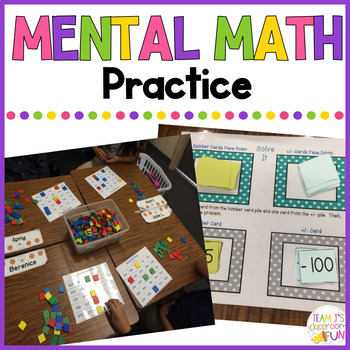
Here's one of the packets I've had waiting in my TPT file to finish and update with picture of my kids in action.  This TPT packet focuses on the math standard - 2.NTB.8 - Mental math adding and subtracting 10 and 100 from any number 0-999.  We did this lesson later in the year which I debated was the right timing.  However, I'm glad I waited.  By April/May, my kids had a stronger foundation with number sense for 3 digit numbers so they had an easier time understanding that the only number changing is either in the tens or hundreds spot depending on if you are adding or subtracting by 10 or 100. 
 
Here are some pictures of my kids playing the Mental Math +/- 10 Bingo. They had a great time playing!


Here's another game in my Mental Math Packet.  This game is called "Solve It." Students flip over a number card.  Then, students flip over a +/- card that tells them to either add or subtract 10 or 100 to the number. Then, students record the number sentence on the recording sheet and solve the problem using mental math.


Here's my pack on TPT - Be sure to check it out - Mental Math Practice
 
Mental Math Practice - 2.NBT.8
 
Thanks for stopping by!


Adding 4 Numbers - 2.NBT.6

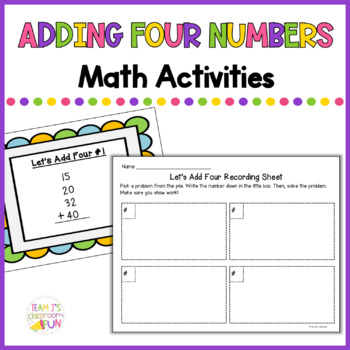
 Last week we spent a lot of time practicing adding four numbers. We started with single digit numbers.  Then, we added in some small double digit with the single digit numbers. Then, we went for it - and mixed single and double digit numbers of any size.  The kids did a wonderful job with this and I was so excited to see them using the strategies we had been working on with addition - looking for combos of 10, doubles, place value, empty number line, and break apart. My kiddos that get break apart have taken it and run with it - and I love it! These are the moments that teachers live for - seeing kids take strategies you've taught and seeing them apply to it to other situations! I'm so proud of them. 

Anyways, for some of activities that I used with my class - I have created a TPT item in my store - Adding 4 Numbers Activities.  Check it out here...

Adding 4 Numbers - 2.NBT.6
 
 
And, here's some kiddos working on they're Roll and Add Game found in my TPT pack above.


And, here's an example of the Story Problems included...
 
 
Be sure to check out my Adding 4 Numbers Packet in my TPT store!  Thanks!


Skip Counting Activities and Stations

We've spent the past week in my second grade class working on 2.NBT.2.  They are doing a great job skip counting and below are the activities and stations we did to practice.

To introduce skip counting, we spent time with counting collections.  I used pom pom balls, snap cubes, unifix cubes, highlighters, popsicle sticks, straws, etc.  Each item had a different number and was given to the partnership on purpose - to help with differentiation.  Higher kids had numbers in the hundreds - lower kids had numbers in the 40s-80s.  The first direction was just to count and tell me how many the had.  I stopped them about halfway through and we talked about how they were counting.  Most weren't organizing the items and most were counting by ones, so we discussed was this a good way or is there a better strategy?  I had two groups who had already figured out a strategy.  One group was counting by 10s and another by 20s.  So, we tried this with an example and decided skip counting was easier and it was easier if you grouped them. We went back to the counting collections and now counted while putting them into groups of 2's, 5's. and 10's.


Next, we worked on a skip counting chart to help us.  We colored all of the numbers that were by 2's yellow, circled all of the numbers by 5's in orange, and underlined the 10's in green.  The kids did a great job with this and then had a resource to use throughout the week (especially with the Skip Counting Task Cards (more info on this below)).
 
After making our own skip counting resource, we worked together to create a Skip Counting Anchor Chart.
 
Throughout the week, I introduced the activities below and then on the last day we used each activity at a station.
 
Station #1 -  Skip Counting Task Cards. I created these and have them in my TPT store here.  We used these whole group first and then they were put into a station.  This provides students with multiple chances to practice counting from and to different numbers.  It also goes up to 1,000 and has a few harder cards to provide differentiation.
 
 
Station #2 - School Bus Bump - I found this on TPT here at Lory Even's store. The kids love bump and now they can play it while practicing skip counting by 10's.

 
Station #3 - Ordering the Numbers - I found a ton of great skip counting resources on TPT.  Here is a sports one to practice skip counting by ordering the numbers.  This one is from a Series of First Grade Event's store, which you can access here.


Station #4 - Skip Counting Puzzles.  The kids loved putting these together. I found some cute Home on the Range ones in Haley O'Connor's store here.


Station #5 - Counting Collections - More counting practice with manipulatives - they were told to practice counting the items while grouping them in 2's, 5's, and 10's.


Thanks for checking out my skip counting ideas. Be sure to check out my Skip Counting Task Cards in my TPT store.

Place Value - 2.NBT.1

Last week, we studied place value specifically the standard 2.NBT.1.  I found a ton of great games and ideas on TPT and even created a few to help my kiddos out.

To start off, we made an anchor chart with some place value examples and things to remember. 
 
Then, after a 4 day study and introduction to the different activities below, we had place value stations on the fifth day. The kiddos loved it!
 
Station #1 - Show Me the Number - this is an activity I created and can be found on my TPT store, here.  This activity offers chances for kids to practice working with 2 digit and 3 digit numbers.  Students can build the numbers using base 10 blocks, draw a place value model, write the number in word form, expanded form, etc.  This provides students with a chance to practice working with multiple numbers.

 
Station #2 - Write the Room - Place Value.  Students got to get some movement in and find the different values of the numbers around the room. I found this on TPT at Shuna Pocket Full of Kinder's Store - this activity is called Place Value Rock.

 
Station #3 - While this picture is upside down, the station was still too great to not share.  This game was called "Mystery Number" and can be found in Love to Learn's TPT store, here.


Station #4 - Roll It, Make It, Expand It can be found at Rebecca Anderton's TPT store, here.  Great chance for students to practice writing the number, modeling it, and expanding it.

 
Station #5- Digit Game - This is a game from our Everyday Math Unit. Students play with a partner and each turn over two cards.  With the 2 cards they have, they need to make the largest number possibly (for example, 28 or 82 - they'd choose 82). The student with the larger number wins.  You can also differentiate this game by having students flip over 3 cards so they need to make the largest 3 digit number.

 
Station #6 - Miss V - Students were put into groups based upon levels. When students met with me, we worked on place value skills that they needed practice on or started to challenge with expanded notation.
 
 
Thanks for checking out my place value ideas.  Be sure to check out - Show Me the Number in my TPT Store.


Doubles Math Station and Fact Family/Addition Station

Again, I'm a few weeks behind, but I still figured why not share.  A few weeks ago we spent time learning about doubles and fact families in math. I found and created some great activities that I wanted to share with you.

Double Math Station
I found this great game Dinosaur Doubles from Oceans of 1st Grade Fun.

I can't remember where I found these cards, but I found a doubles memory game that I then glued to cardstock. The kids love playing this!

Here is a Doubles Tree Map activity that I created. You can find it as a freebie in my TPT store, here.  This activity gives kids a chance to practice their facts, learn some vocab, and use the tree map to organize their doubles facts.
 
 
Another station I added, included this great Fact Family Triangle I found at This Reading Mama's Blog.


And, my last game addition is a math game from Everyday Math. Students start their counters at 1 and roll the die to move up. The first person to 120 wins. The neat thing about this game though is if you roll a 1, you can choose to move 1 or 10. If you roll a 2, you can choose to move 2 or 20. It's a great way to start adding up 10's from different numbers.


These are a few of the additions to my math stations. Stay tuned for more as the year continues and please check out my Doubles Tree Map freebie in my TPT store.
 

Math Stations - Introduction Round

For my Math Stations, I use Debbie Diller's Math Workstations book as my guide. Math Stations change throughout the year and the best part is that they incorporate games we've already played.  So, it's more review for the kids and also less prep because the games are already there, ready, and taught.  I change out my Math Stations about every 3-4 weeks depending on how often we've got to them.  I have 12 stations in my room.  Stations 1-10 are in storage bins, Station 11 is computers, and Station 12 is the SmartBoard. For Stations 1-10, I have doubles of each station.  For example, Station 1 is the same as Station 6, Station 2 is the same as Station 7, etc.  This way, it's more review for the kids.  They might play Station 1 game on Monday and then the next Tuesday they'll review those games again at Station 6.  This way they're getting lots of practice, but it's not the same thing two days in a row.

For my introduction stations, I make them easy and a little bit more of an exploration station.  The reason I do this is because I focus more on the management piece of stations.  We go over our Math Station Expectations, we go over how to work with partners, we go over how to use  math tools correctly, and how to keep our voices at a Level 1 Whisper Voice during stations.  I also don't pull math groups during the introduction stations.  During this time, I'm walking around the room helping kids work together, complimenting the good things I see (partners sharing, Level 1 voices, etc), and making sure the management piece is there.  I find by doing this it makes it so much easier to pull groups in following weeks because I've laid the foundation down during the introduction unit of how stations should be.

Here are my introduction stations:

Station 1 and Station 6 - Time Exploration.  In this bin, I have time puzzles, a book on time, two mini clocks for the kids to explore, and the large Judy clock.


Stations 2, 7 - 10 Frame Station.  In this station, I have counting books, blank 10 and 20 frames,  and counters.  They can build numbers on the 10 and 20 frame and work on finding out how many more they need to fill it.


Stations 3, 8 - Place Value.  For the place value station, I have place value books and the place value game.  For the place value game, students need a place value mat (one side for the ones and one side for the 10s), a dice, a 10 frame, and unifix cubes.  Students roll the dice and then fill in how many ones they got on the one side of their board.  Then, students roll again.  Once they have ten ones, they put them together to make a ten stick, and move it over to the tens side. This game is a great way for them to really see how to make the ten and actually gives them a chance to do it (I always start place value this way and then move to the base 10 blocks).


Stations 4, 8 - Addition Practice.  At this station, I have addition books for the kids to read, addition flashcards, and the game from our Everyday Math Curriculum Addition Top-It.


Stations 5, 10 - Geometry Exploration. At this station, I have math books for the kids to read, attribute blocks for the kids to explore, and geoboards and rubber bands.


Station 11 - Computer Math Games. At this station, I have various online math games and math practice for kids to play.


Station 12 - Smart Board Station. I don't have this station up and running during the introduction stations, but I will have more info in it on the next round.


Hope everyone enjoys the rest of their weekend!