Showing posts with label Math. Show all posts

Holiday Activities for the Classroom

I know how crazy the last few days/week before winter break can be. We are entering crazy times teachers and we need to have as many fun, educational activities in our back pocket ready to go as we can.

So, here are a few things I will be using with my class this week....


Christmas Writing Prompts - This is a FREEBIE in my TPT Store.  It includes two writing prompts that are focused on personal narratives.  Great way to incorporate writing into the holiday excitement.


Candy Cane Science Lab - I did this activity with my class last year and will be starting it this week. We've been learning about lab reports during Writing Workshop and this is a fun science experiment to do this time of year. Check out my blog post on it....here...

Olive, the Other Reindeer Book Study - This is a cute story and my students love hearing it every year.  This book study is now in my TPT Store. It includes comprehension questions and four different writing prompts. This could be used whole group or as a small group activity.


Christmas Story Problems - We will be starting these today.  I love using holiday story problems as one of my rotations during our daily math time.  The kids love that they are themed and fitting of the season.  The Christmas Story Problems include addition and subtraction problems with and without regrouping.


Winter Story Problems - I will actually be using these when we return to school in January, but if your school focuses on winter instead of the specific holidays - these story problems would be great. These can be used whole group, small group, or at a math center.  These winter themed problems focus on ice skating, hot chocolate, snowmen, etc.  Includes addition and subtraction problems.

Hope these activities and ideas help with the last bit of school before break. I'm down to 7.5 days left with students. We can do it teachers!

Teaching with Math Misconceptions

I love using Number Talks and CGI strategies in my math class. We recently had our CGI trainer visit and she mentioned that you can also do Number Talks while clearing up math misconceptions. I loved the idea and decided to give it a try when we were learning subtraction.

With subtraction, one of the misconceptions I noticed, was that students seemed to think when you regrouped you just put the number there. For example, if you were regrouping 100 you just put 100 there and the tens that existed before just went away.  I noticed a few of my students doing this when regrouping with hundreds, tens, and ones so I decided to have a little math misconceptions talk.

I first wrote this problem below on the board. I told students this was the math work from a former student and I wanted them to look at it and see if they think they student got the answer correct or wrong. If they got the answer correct, then you need to figure out how you know that. If they did not get the answer correct, where did they make a mistake in their work. I posed this problem and gave students a few minutes of quiet think time.


After a few minutes of think time, I had the students turn and talk and discuss with their partner what they noticed. I had some students who thought the answer was correct and some who thought it was incorrect. I asked students who felt strongly about both to explain why they thought they were right.  The children who thought it was right were some of my students who were making that same mistake.  As they were explaining why it was right, I asked them - where did the 20 go that was already in the tens spot? I then had many aha's around the room. I had a child who thought the answer was incorrect walk us through the problem and corrected the original work. I showed this in a different color so we could see the misconception.  See the new work below...


This was an amazing class discussion and I plan on having many more Math Misconception Number Talks. I think it's important for students to always be thinking and observing their work and others when we are sharing out.  This is a great way to go over mistakes that you are seeing and it points it out in a way that doesn't make the child feel bad.  It empowers them to see the mistake in someone else's work (I always say a former student and make up a name) and then they are more likely to catch it themselves when they do it.

Do you use Number or Math Talks in your classroom? Comment below...


Teaching Repeating Patterns Ideas

We recently worked on patterns in math. In second grade, students work on repeating patterns and growing patterns.

Students have typically been doing repeating patterns for a long time and are able to identify the next shapes or letters so we add more to it in second grade. In addition to identifying the next part of the pattern, students also need to be able to identify the unit, create their own pattern, and identify what the 20th shape would be and so on.  This takes things up a notch and it's interesting to see the different strategies they use to figure out the 20th shape, 40th shape, 55th shape, etc.

Here is our anchor chart we created as a class.

In addition to small group work and patterns practice on IXL, students also worked on the Repeating Patterns Task Cards. These can be found in my TPT Store (Jordan Johnson).  This includes 20 task cards that ask different types of questions all revolving around repeating patterns.  A recording sheet and answer key are also included. This worked well as an activity during my math rotations, but could also be used in small groups, math stations, or as a review activity.  Check it out in my store...here...


IXL

So I don't know what I did before IXL.  IXL is an online practice program that has language arts, math skills, and more. My school just purchased it for our grade level and I love it already! The kids also love it too and ask to play it! That is a refreshing change from the groans I used to get when we'd work on some of our other math programs.  We've mainly been using IXL for  math so I'm going to share a few of my favorite things about it....

Image result for ixl


  • Differentiation
    • With IXL you have access to multiple grade levels and skills, which allows you to have kids move at their own pace.  I teach second and I can use first grade practice for some of my struggling students and use third grade practice for students who have mastered the second grade skill and need a challenge.
  • Real Time Data
    • This is the best part of IXL.  They have real time data. I can have my students working on IXL in class and/or in study hall and see exactly how they are doing and what they are doing. It lets you know if a student has missed so many and is struggling and needs help.  This instant access to how they are doing is fantastic!
  • Multiple Skills
    • As I mentioned in my differentiation point, there are many skills for each topic. For example, we've been working on patterns. It has repeating patterns and growing patterns and different variations of each. I love that there are many options and that it covers so many math and language arts skills.
  • Instant Feedback for Students and Teacher
    • This is why I like using it especially for homework. Feedback is instant. Once the student submits their answer they know right away if they got it correct or if they got it wrong. If they got it wrong it coaches them through some tips to see what they did wrong.
  • Appropriate amounts of practice 
    • I'm not a fan of worksheets and I've been saying this for years. I do not think every child needs to be doing 50 problems on a worksheet to show they have mastered something. Some kids do need more problems to demonstrate mastery, but some can demonstrate it in 10 problems instead of 50.  As they get problems right on IXL, it moves them closer to 100 as they get them wrong the lose points. It gives them the practice they need. If a child understands the skill it gives them a few problems to show that and then they are done.  I like that it isn't drill and kill - a billion problems that many students do not need.
So there you have it - some of the reasons why I love IXL. I'm still learning so I'm sure there are more features, but I am a fan so far!

Ideas for Teaching Rounding

Every year, without fail, rounding has been one of the harder concepts to teach and one of the harder ones for kids to understand. Before starting our unit this year, I did a little research on Pinterest and came across this aha moment and wonderful idea from Mr. Elementary Math - vertical number lines! While yes a horizontal line will work, it's confusing when we tell kids to round up and down because on a horizontal line you're really moving left or right.  This is where vertical number lines come in.  You really are rounding up or down and visually it's much easier for kids to see. Check out Mr. Elementary Math's ideas for interactive number lines here...

Here's how I started my rounding introduction....
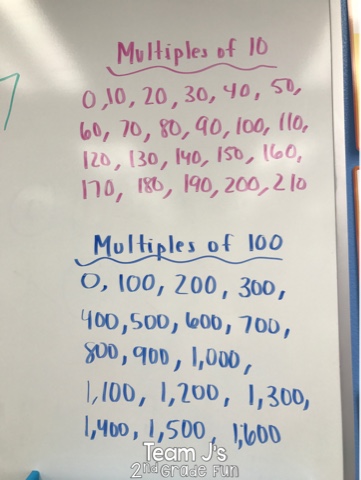
So, we started by creating a list of multiples.To make it easier to figure out the two numbers that it was between, we created a list of multiples of ten and multiples of 100. While yes most kids are quite capable of counting by 10, it's amazing how when you are talking about rounding some of those common skills go out the window.

Then, we created the anchor chart below and went through a few examples together...  Here you can see the vertical number line in action. The lower number goes on the bottom of the vertical number line and the higher number goes on the top. Then the kids place the number and see which it is closer to.  Then, they literally round down or up depending on where the number is. This made rounding so much easier for so many of my students!

To review - we played this rounding game called Roll It. This game is from Game for Gains and can be found....here....
Want a FREE rounding game to use in your math centers tomorrow? Learn how to play this differentiated Roll It! Rounding Game. You'll even get our free game boards to use!

Hope these tips are helpful for you!  Vertical number lines have changed how I teach rounding and I'm so glad I found it!


Ideas for Teaching Properties of Addition + a FREEBIE

We recently finished up our unit on Properties of Addition. This is always a tough unit for kids.  While they are able to add - being able to identify the properties and figure out missing numbers has always been challenging.

Below is the anchor chart we created together the first day after exploring each property using a balance scale...see below.

I saw the balanced scale idea online.  Using unifix cubes/snap cubes you can show each property and the balance scale is perfect because it shows how things are equal no matter what order they are done in.  The picture below shows the Associative Property.  We had (4+2) + 3 on one side and then (3+2) + 4 on the other. We discussed how both equals 9 and the scale is balanced because it's the same sum. This then led to the chart discussion about how it doesn't matter which way you group the numbers you're adding - the sum will still be the same.


After learning the three properties, I had students practice whole group. I projected my Properties of Addition Practice (a freebie in my TPT store) on the board and students responded to the questions on their individual white boards. 

Below's slide is asking them to identify which property is shown in the equation...


This slide is asking them to find the missing number that goes in the blank.  We talk a lot about how you want to look and see which numbers are there and which one is missing. Since you see 2 on the other side and not 5 - 5 must be the missing number to make this equation equal.


If Properties of Addition is something you teach - check out my freebie! Great way for kids to practice this skill whole group.


Ideas for Teaching Subtraction

We recently finished up our unit on subtraction and I wanted to share with you a few activities and things that we worked on. I teach second grade and our goal is for students to be able to subtract 2 and 3-digit numbers with and without regrouping. We also use CGI (Cognitively Guided Instruction) at our school so there is more than one strategy that can lead you to the correct answer.

Below is the anchor chart that we created as a class. We worked on a different strategy each day.  Day 1 was place value. I started off with a story problem and then had a student share who had used that strategy. Then, we added it to the chart and practiced whole group and small group. This continued until each strategy was added. After practicing and trying each strategy, students were able to pick the strategy that works best for them.


I use a lot of small group instruction now during math and we have math rotations 3-4 times a week. Here one of my groups is working on a 3-digit subtraction problem. As you can see, everyone is solving it in a way that works for them!

Also during rotations we have game time.  I introduced Subtraction Memory first. Subtraction Memory is a game that focuses on 2-digit subtraction. There are two versions. One version doesn't have regrouping and the second version has problems with and without regrouping for differentiation.  It can be found in my TPT store...here...

As the week continued I changed the game up.  Later in the week students worked on Subtraction True/False Sort. This activity is also differentiated to help all learners. Version 1 has 10 problems to sort and the problems are a little simpler. Version 2 has 20 problems to sort and they have more difficulty. This is a great activity for students to practice the different strategies and work together to see if the problem is true or false.  This can also be found in my TPT store...here...

Check back later this week for another round of math ideas - this time for Properties of Addition and it will include a FREEBIE!

Story Problem Tip #4

Today I'm sharing with you my last story problem tip for the month! If you missed my past tips, check them out below...

Today's tip is all about students creating their own story problems. Another way to get buy in and engagement is to let students write their own story problems.  Students love it because it can be about what they like and can be about themselves or their friends. This also offers a chance for differentiation. Some students can write multiplication problems, while some might still be working on addition.  Students can also be working with numbers that fit their comfort level. 

The other neat thing you can do is let other kids solve their story problems. In the past, after having kids write their own story problems - I type them up and then have the class work on them.  They loved it!  While it can be "fun" solving the teacher's problems, it's even better solving their friends.

If you are interested in this tip, check out my Create Your Own Multiplication Story Problems product on TPT here...

Story Problem Tip #3

It's Tuesday, so I'm back with another tip for using Story Problems in the classroom.  

For past tips...

So, today I'm sharing tip #3 with you.  My third tip is to let students share their strategies with each other.  

Every Friday in my class we do two story problems. Both story problems are similar - meaning same type, same operation, but different numbers.  I read the first story problem to students and then send them back to their seat to solve it. 

While they're solving, I circle the room and check out what strategies they are using. I then selectively pick a few students to share their strategies with the class.  By selectively, I mean I pick strategies we're focusing on or efficient strategies that I'm hoping more kids will use. I also pick a variety. I do not typically have the same strategy shared - I choose all different ones.

Then, I have each child that I picked come up one at a time to share their strategy with the class.  The audience is supposed to pay attention and see if they can pick up  new strategies that they could use next time. This is also great for kids who didn't get the right answer or didn't know how to solve it. They can now see how their classmates did it and get ideas from them.

I normally use my iPad stand as a doc camera and project their work on the board. The child presenting stands up and explains how they solved it. Some students can explain on their own, while some need some probing questions to get all of the info out.  The pictures below are from a day when technology was not in my favor. I had the students who were picked write on the board how they solved it. While they were writing they explained what they were doing.


This tip is great for many reasons. It lets students teach each other. Students get tired of hearing us all day so it's nice when they can hear the same thing from someone else. It provides opportunities for math communication, which is a huge part of math nowadays.  It also builds math confidence.

Check back next week for my final story problem tip!

Story Problem Tip #2

As I mentioned in my post about Story Problem Tip #1, story problems are a huge part of math. It's so important that we provide students opportunities to use math with real world situations.  Last week I talked about how students tend to dread word problems. The see words in math and tend to freak out - it's just supposed to be numbers! That's why I started this little mini blog series.  You can find tip #1...here...

So, for tip #2 to make story problems a little more fun, let the students choose their numbers. A huge part of differentiation is choice.  My example below is from when I taught first grade, but you could change the numbers and story problem skill to fit any grade level.


I often give 3 choices.  One for my struggling students, one for my on-level students, and higher numbers to challenge my kids who are ready.  I let kids pick the numbers. However, I do go around and monitor their choices. If students pick one that is too easy, after they solve it, I suggest they try the larger numbers.  If students pick one too hard for their ability, I suggest they try a different one first and then they can try to go back to that one.

Kids love choice and by giving them choice with story problems we are differentiating for their needs, which will make story problems seem less dreaded and impossible.


Story Problem Tip #1

Every Tuesday during the month of September I'll be sharing tips for using story problems in your classroom. While these story problems are often dreaded for most children, they are such an important part of math and a practical real-world application.  So, it's important that they practice them and that they hopefully become less dreaded in the process.  Here's tip #1 for how I make them less dreaded...

Use student's names in your story problems. Kids love being included. Especially if you can include a hobby or something you know they are interested in.  We do weekly (every Friday) story problems in my class.  I use my student's names in the story problems. They always get excited to see who the story problem is about! It's also fun to put in interests and real-life things for them.  The more excited they are to start, the more excited they'll be to solve it!


Check back next Tuesday for my second story problem tip!

Division - Tip for Conceptual Understanding

I'm popping on today to share a quick division tip focused on students' conceptual understanding of division...

We use CGI (Cognitively Guided Instruction) at my school and I am a huge fan! I know this is not the first blog post that you've heard me say that. I've actually used CGI at multiple schools and have probably been using it for 8 years.  CGI focuses on students really having a solid grasp on the conceptual understanding of a topic. Gone are the days of just memorize a bunch of formulas, but you have no idea how or why you are doing that. That is why I love CGI. The focus is on kids understanding, not just getting the right answer. Now, don't get me wrong, I do know most math problems typically only have one right answer, but CGI focuses on the understanding and that there can be more than one way (strategy) to get to that correct answer.

I recently used CGI with my summer school students.  Division is a skill that can be hard for kids to understand so we broke it down and made it visual for them.  For the problem below, 18 divided by 6, I had them pull out 18 counters. We discussed that the first number is the whole number of what they are starting with.  You can see this student organized them using the 10 frame (my favorite!).


Then we talked about dividing meaning that we needed to separate them into equal groups of 6. So, they physically moved the 18 counters and separated them into groups of 6.


Last, we counted the number of groups they were divided into and they came up with 3 groups. We also talked about how it was related to multiplication and how they are fact families. The visual made it easier because they were able to see that from their work with the division problem, that the multiplication problem was right there.  On the board, they had three equal groups of 6 which equaled 18.  This visual helped tremendously and helped them make the connection between multiplication and division! 


Day 1 of the TPT Back to School Sale

Yay! The Back to School Sale is finally here! My entire store - Jordan Johnson - will be on sale for 25% off with the code BTS2017.  Check out one of my newer products below! Great for the beginning of the school year.


I know many of us start out with Place Value lessons in the beginning of the school year! My newest bundle (Place Value Bundle) will help provide quick practice in multiple place value skills.  It includes mainly 3 and 4 digit numbers (one Show Me the Number focuses on 2 and 3-digit numbers).  It covers creating place value models, writing numbers in expanded form, writing numbers in standard form, and reading numbers.  The last activity shown - Place Value Review - Around the Room covers those skills plus comparing numbers and adding using expanded form. 

Check it out in my store! It is part of the sale and will be 25% off with the code BTS2017.


Friday Favorites - Math Activities

Every Friday this summer I am sharing some of my favorite things with you! The month of July is focused on technology and academic areas.

Check out past Friday Favorites...
PD Books
Read Alouds
Kids' Favorite Series
Book Studies

I love teaching math so it was hard to pick just a few of my favorite math activities to share with you, but I was able to do it! The activities I'm sharing below are mostly geared towards second grade, but could apply to high first graders or low third graders. You'll also notice there are a few activities with food. I find that anytime you can add food to a lesson - the lesson becomes more engaging!  I also try to incorporate as many hands-on lessons and math games as I can to help keep students engaged.

Check out a few of my favorite math activities...

Counting to 1,000 Book - One of the second grade standards is that students are able to count and write their numbers to 1,000.  So for an activity (we started whole group and then students would work on it when they finished work early) I had students write their numbers from 1-1,000. They would do one paper at a time and then I would check it. This allowed for quick feedback and made sure students didn't get too carried away with incorrect numbers.  When they were finished, it was put together in a book that they could take home.  They loved the fact that they got to decorate the front cover.


Making 2D Shapes - As I mentioned, I like to incorporate food into lessons when I can. I saw this online and can't remember the exact source, but it worked perfectly. We had been studying 2D shapes and their attributes. As a way to practice, students created shapes using pretzels and marshmallows. This lesson was a hit and the kids loved trying to create the harder shapes with more sides.


Arrays with Skittles - Another great food lesson. I like to break out the Skittles when we start working on arrays.  Students like below can make the array that fits the equation. For example, 3 x 7 - they make 3 rows with 7 Skittles in each row and then count to find the product.   They also enjoy the Skittles when we are finished!


Race to Zero - This is a fun, competitive game that focuses on subtraction and strategy.  Students can play in teams, partners, individually, etc. The goal is to be the first person to zero. Each team gets 3 dice and starts at the number 999. They decide how many dice to roll and then once they've rolled, they decide what order to put the numbers in. Then, they subtract. This continues until one team reaches zero. The interesting thing about this game is that it focuses on being strategic and using the right number of dice at the right time and really thinking about the best order to put the numbers in to maximize your turn.  I love having the kids play this for an activity during Morning Meeting.


Lucky Charms Graphing - Back to the food again! I again do not know where I got the worksheets I used, but there are many different Lucky Charms graphing packets out there.  The kids have fun picking out the marshmallows and graphing the totals that they have.  It also gives you a chance to ask some data analysis questions which focuses on number sense, addition, and subtraction.

Create Your Own Graphing Project - This is a fun project that my students always enjoy working on. Once we've learned about the different types of graphs, students work with a group on a project where they create their own graph. The group comes up with their survey question, surveys students, creates the graph, analyzes the data, and presents their findings to the class. It's a great project to use to wrap up the graphing unit. You can find this in my TPT store... Create Your Own Graph Project.


Thanks for stopping by! Next week I'll share some of my favorite reading lessons and activities!

New Place Value Products

I'm so excited to share some new Place Value products that I have been working on this summer. These are perfect for Fall as most of us start our math units teaching or reviewing place value.  Both of these are geared towards second grade.

In Read It, students are practicing reading numbers out loud. One of our standards (we use ERB) is for students to be able to correctly read up to 5-digit numbers.  Read It is differentiated and includes practice with 2-digit up to 6-digit numbers.  This is a partner or independent activity. Students can take turns reading the numbers to each other and then pick a new card.


In Write It, students are practicing reading and writing numbers. First, students read the number on the card, which is written in word form. Then, they write the number in standard form on their recording sheet.  Write It includes 3-digit and 4-digit numbers. This activity is best used as Around the Room.


Both activities offer a color version and a black and white version.  Check them out in my TPT store by clicking on the pictures below.  


Five for Friday - May 19

Man...oh...man... the end of school is always so crazy!  Anyone else feeling like they can barely keep up??? Even with all of the crazy, I'm still linking up with Kacey at Doodle Bug's Teaching for another Five for Friday...


Every year students complete a Think Like a Disciplinarian Project. This an ongoing project that takes the entire year. Students spend time researching their discipline (what it entails, tools, vocabulary, noted practitioners, interview someone in the field), write a report, and then share a presentation with the class. We started presentations this week and I've been blown away! The kids have all done an amazing job! Here are two to share - one student who did a poster about being a baseball player.  The other student studied being a chef and brought in her own recipe! Love the creativity!


We've been working on fractions this week. I love Amy Lemon's Fraction Fanatic packet on TPT. If you teach fractions and are in 2nd grade - this is a great resource! I also love these flip books from Lakeshore. Great practice of matching up the fraction, picture, and picture representation of the fraction in sets.

Our awesome headmaster gave us a nice treat this week! He had a Coffee Bean catering truck on campus Tuesday morning.  The entire staff was treated to yummy drinks and pastries!


Here's a quick formative assessment idea...one of our standards is students being able to identify 2D and 3D shapes and compare and contrast two 2D shapes.  We do have a paper assessment, but I also like to have the kids come back and test them one on one. I use the picture - they identify the two 2D figures. Then, they identify the two 3D models.  Last I have them compare and contrast the two figures on the page.  It's quick, simple and I like that I get to discuss it with them.  Paper assessments are great too, but I do enjoy the observational assessments too!

Last weekend, my husband and I checked out Top Golf Las Vegas! What a fun place! Lots of golf options, pools, concert venue - it has it all! Do you have a Top Golf near you?

Have a wonderful weekend! 8 days to go with kids!