Making Inferences - Part 2

We spent a total of three weeks of making inferences so that the kids really had an opportunity to master the skill.  The first blog post part 1, shows some of the introduction ideas we used. As I mentioned in that post, we started by teaching concrete examples and later moved to making inferences about text.

Day #4 - From Tanny McGregor's, Comprehension Connections - Shoe Inference Lesson
For this lesson, you bring in a shoe and the kids have to infer who's shoe they think it is and why.  Now, I live by myself so I knew if I brought in one of my shoes they'd easily guess it, so I asked my dad if I could borrow one of his sandals.  The kids had so much fun trying to come up with ideas of the owner of the sandal and using the evidence from the sandal and their schema. See chart below...


Day #5 - The Mystery Box - idea from Inspired Apple's Blog 
For this lesson, I pretty much followed Abby's example on her blog and even used the valentine as my mystery item (the timing worked out well with Valentine's Day a week or two away). We made guesses about what was in the box, then I gave the kids clues, and they filled out the mystery box sheet that Abby has in her TPT store. Great lesson and the kids had fun trying to guess the mystery item.

Day #6 - Making inferences with pictures
Today we used pictures as our evidence for our inferences. I found this great pinboard on Pinterest that has a ton of pictures that are perfect for making inferences. I put some of the photos into a Smart Board file and I was all ready to go for this lesson.  For the first few slides, we made group inferences.  We talked about what some of the different clues or evidence in the picture were that led to our inference.  Then, after multiple group inferences, I showed them two more pictures. The kiddos had to pick one picture to make an inference about. Then, I showed them their inference paper to fill out. They needed to write their inference using one of the inference phrases (see chart below) and then also explain how they go their inference.  Most students sentence frame looked like this..."I infer _______ because ______.  The kids did a great job with this activity!


Day #7 - Inferences with Short Pixar Videos
Our school literacy coach told me about this great idea - using Pixar short films for inferencing. I found a number of them on Youtube and chose the bird one that if I remember correctly was in one of the Toy Story movies.  The kids thought it was so funny and we watched the video a few times.  The last time we watched it (it's only like 3 minutes long) I stopped it a few times and asked some questions to get the kids thinking about inferences they could make.  Then, I gave them the same inference form they used with the pictures and they had to write down one of the inferences they made from the video.
 
This student wrote "I infer the big bird wanted to be their friends because he waved at them."
 
Day #8 - Mystery Box again
The kids had so much fun with the mystery box that I decided to do it again. This time I put green sprinkles in the box and used the following clues:
1. It is green.
2. It can be eaten.
3. It is small.
4. It goes on dessert.
See our chart below of our guesses before and after the clues.
 
Day # 9 - Making Inferences with a Poem
Day 9's lesson came from Debbie Miller's, Reading with Meaning chapter on making inferences.  I wanted the kids to start exploring inferences with text and thought a poem would be a great way to start.  I used the poem from her book, which is about an animal, but the kids don't know what animal it is. They have to infer from the clues in the poem what possible animals it could be. The kids love animals and this was a great way for them to start inferring with text since poems are a little shorter.
 
Day #10 and 11 - Where Are You Going, Manyoni?
For day 10 and 11, I again used Debbie Miller's, Reading with Meaning. We read the story, Where Are You Going, Manyoni? and inferred what some of the different words meant. See our chart below...
 
Days #12 and 13 - The Royal Bee
Day 12 and 13's lessons are also from Debbie Miller's, Reading with Meaning.  On the first day, we read a few pages of the story, The Royal Bee and inferred what a few of the vocabulary words meant - yangmin, Royal Bee, etc.  Then, we stopped at the part where the kids had to infer what would happen next for the main character Song-ho. I charted their inferences on the first day. Then, on day 2, they got to see if their inferences were correct.  Then, I read to the part where it came down to the winner of the Royal Bee and the kids had to predict/infer whether Song-ho or the yangmin student would win.  The kids had great answers and great evidence. See a few examples below...
 
I predict Song-ho will win the Royal Bee because Song-ho is smart and his whole class picked him to go to the Royal Bee.
 
I predict Song-ho will win the Royal Bee because he stand at the door and listened to the master's lessons.


That about covers it for our 3 weeks of making inferences. This was probably one of my favorite units to teach this year.


End Marks

This is just a quick post, but I wanted to share our whole class anchor chart on end marks. We've really been working on how to write a sentence in first grade and teaching end marks is one part of it. While we are still working on mastery of this skill, we have the anchor chart below to refer to.

Making Inferences - Part 1

This week we started teaching inferences in first grade.  We decided to start with concrete examples this week and then move into making inferences with text once they had the inferring skill down a little better.  For teaching inferences, I've gotten many ideas from Comprehension Connections by Tanny McGregor. She has wonderful ideas that are scaffolded to help support student learning.  I also got some great ideas from the blog, The Inspired Apple. Abby has some fun ideas for how to intitate inferring with students. 

On Day #1 - we started with The Inspired Apple's - What is in my teacher's bag?  The kids loved this! They thought it was so cool to be able to see things that were in my purse. I carefully selected my keys, wallet, iPod, cell phone, gum, and water bottle.  The first day we talked about each item and came up with reasons why it might be in my purse. We then charted those reasons. On Day #2, the kids filled out Abby's cute page for What's in my teacher's bag? 

Our Chart
 
Thank you Abby for these great student sheets!


On Day #3 - I used the idea from Tanny's book, Comprehension Connections called "Neighbor's Trash." You start off by explaining to your kiddos that you have a mystery that you need help figuring out. The mystery is that you have no idea who your next door neighbors are. You've never seen them, never met them, never heard them, etc, but you know someone lives there.  So, one morning you saw their trash outside and decided to take it to investigate. At this point, my kids thought I were crazy. Why would Miss V take her neighbor's trash? Some of my kids suggested, why don't you just knock on their day and be friendly lol.  Little do they realize this is all trash from my house. Like the teacher bag activity, you show them the items you found and they come up with inferences for who might live there based on the trash.  In my "neighbor's" trash, we found a large pizza box, Ace bandage, empty Capri Sun pouch, Gap bag, receipt for a new TV, and a plane ticket.  See the chart we came up with below.
 
 
We also came up with an inference chart for ways to talk about inferences - my kids have gotten really good about starting their inference using the phrases below...
 
More inference ideas coming soon!


Creating Mental Images

Creating mental images is one of my favorite reading comprehension units to teach.  For mental images, I use a lot of ideas from Debbie Miller's book, Reading with Meaning.  Below are a few of the lessons and activities we did in my classroom.

Using Poems to Create Mental Images from Reading with Meaning:
Each child got to pick one of the four poems that they had the best mental image for and drew their image. Afterwards, we looked at each image and noticed that even if the image was for the same poem each image was different because everyone has different schema. Below I have pictures of the bulletin for this activity that is also found in Miller's book.


Most Vivid Mental Image:
 
Using the stories, A Bad Case of the Stripes and Pigsty, students had to pick their most vivid mental image to complete the mental image handout. These stories are fantastic for mental images and provide great details to help students create the image in their head.


We worked on some other lessons from her book, but unfortunately I didn't get pictures of those lessons.


100th Day of School

We had our 100th day of school a week or two ago and we had a blast.  The 100th day of school celebration is always a lot of fun and we added some great new activities to our celebration this year.

Finding 100 Words
This page I found on atozteacherstuff.com.  The kids take clipboards, their paper, and go around the classroom trying to find 100 words to write down. They love this activity and they always get excited to see how many words they can find. 


Story and 100 Things Activity
Then, we read the story 100th Day Worries and decided what we would collect if we needed to collect 100 Things. The cute 100 Things collection page comes from FirstGradeBlueSkies Teacher's Pay Teachers page.  She did a great job designing these cute 100th day pages and the best part of all...they are FREE!

 
I would have 100 clothes because they are so very stylish.


I would have 100 diamonds because they are so very shiny.


Special 100th Day Glasses
This is one of my favorite activities that I've done every year in first grade. This one just takes a die cut machine for the numbers and a craft stick.  These special glasses are decorated by the kiddos and then used with a math activity later in the day.


Math - Find 100 Stars:
For this activity, the kiddos use their special 100th day glasses. Now, these glasses have magic powers. These glasses make it possible for the kids to find the 100 stars I've hidden around the classroom.  For this activity, the night before, I hide 100 stars (with the numbers 1 through 100 written on them) around the room. Some in easy locations and some in some harder locations.  The kids use their special glasses and search the room for the stars. Then, after about two minutes, we start filling in the 100's pocket chart.  After filling in the stars we've found, we then see what we're missing and go on the hunt again. Some years you end up losing a star or two, but it's always funny to see how excited they get when they find that missing star a month after 100th day.
 
Hidden Stars:


Pocket Chart:


To end our day, we talked about what we would buy with $100 and filled it in on a cute worksheet. It's pretty funny to see what the kids think they can buy with $100.  Afterwards, we decorated this cute 100th Day Bookmark that my teacher candidate found.
 
Hope everyone had or a has a great 100th day of school!


New Year's Resolutions

I'm aware New Year's was a few weeks ago, but this is one of my favorite activities so I had to post it.  Every year on the first day back from Winter Break we talk about New Year's resolutions.  I always start by reading the book Squirrel's New Year's Resolution. This book puts explaining a resolution in simple terms and also shows some examples that the kids understand.


After reading the story, we come up with a list of resolutions. The kids pick things like - "I will read more books, I will try to stay on green, I will try to help people, etc.  Then, they write their resolution on a piece of "toast" (used the die cut machine at school) and we make a "Toast to 2013." See bulletin and examples below.


I want to help others be good students.
 

I want to be a better reader.
 
I want to make people happy.
 
 
And, a belated Happy New Year's to everyone!


Time flies....

Wow - I have absolutely no idea where December and half of January has gone.  Things got pretty busy as they do during the holiday season so now I have lots of catching up to do with  my blog. Look for lots of blog entries today and I apologize that some are out of order (a New Year's post), but I figure better late then never.  Hope everyone is enjoying their 3 day weekend!

Brave Irene - Setting Brace Map

Over the last week, we started reviewing literary elements again.  Identifying the setting was the one area of literary elements that our first graders struggled with the most.  On Friday, we read the story Brave Irene (great story by the way) and came up with the 3 settings from the story.  We used a brace map to display the settings and then added evidence that supported the setting identifiation. The kiddos did great with it.  See below....

Day #8 - Nonfiction Text Features - Glossary

For the last day of studying nonfiction text features, we learned about the glossary.  Day #2 of the blog posts has further instructions as to how I laid out each lesson.

Here is my teacher example:
 
 
Here are a few student examples:


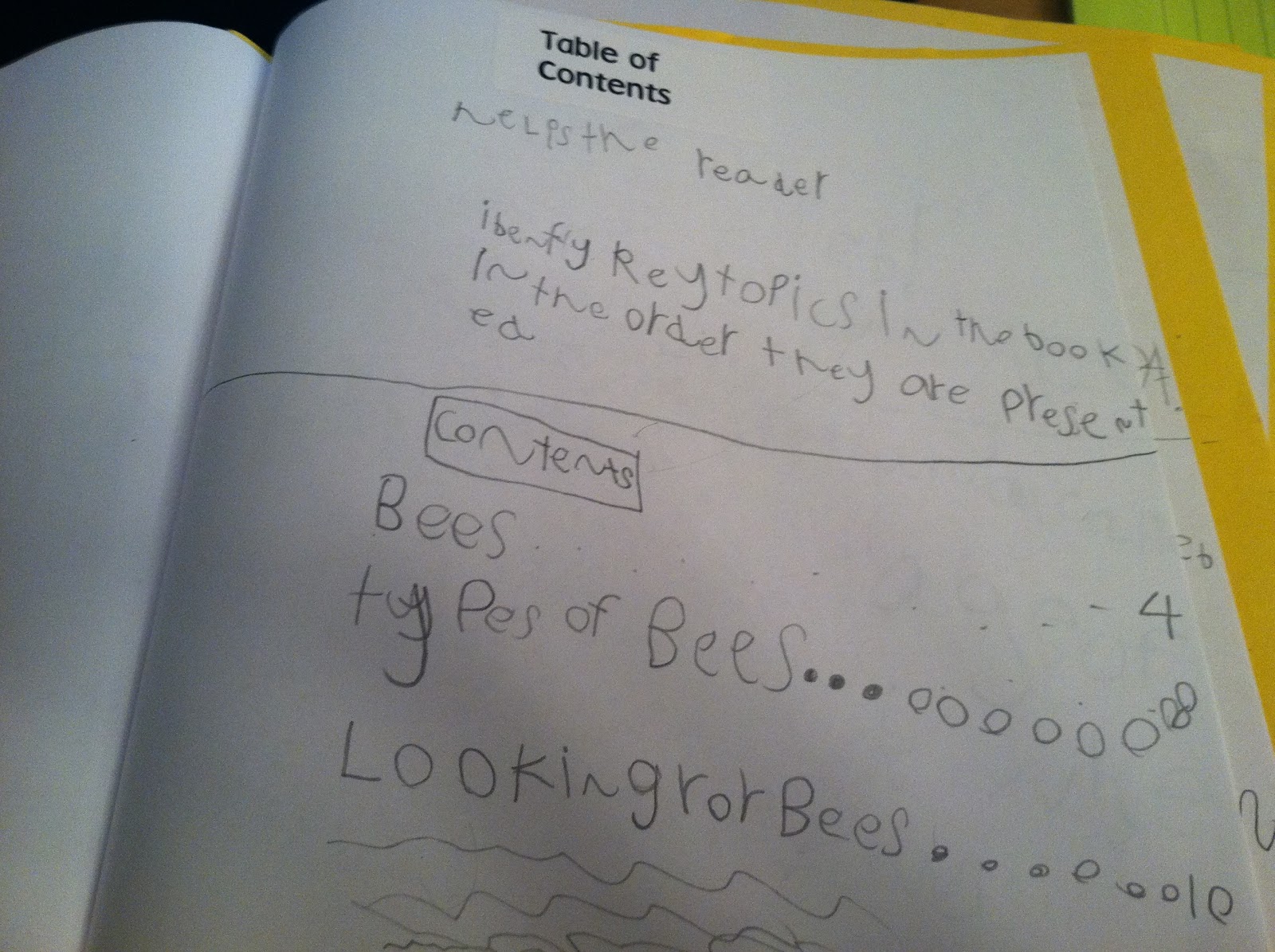
Day #7 - Nonfiction Text Features - Table of Contents

Day #7 we learned about Table of Contents. Again, look at post for Day #2 to see how I laid out the lesson.

Here is my teacher example:
 
 
Here are a few student examples: